What Makes Japanese Lace Different
Japanese Lingerie
What Makes Japanese Lace Different?
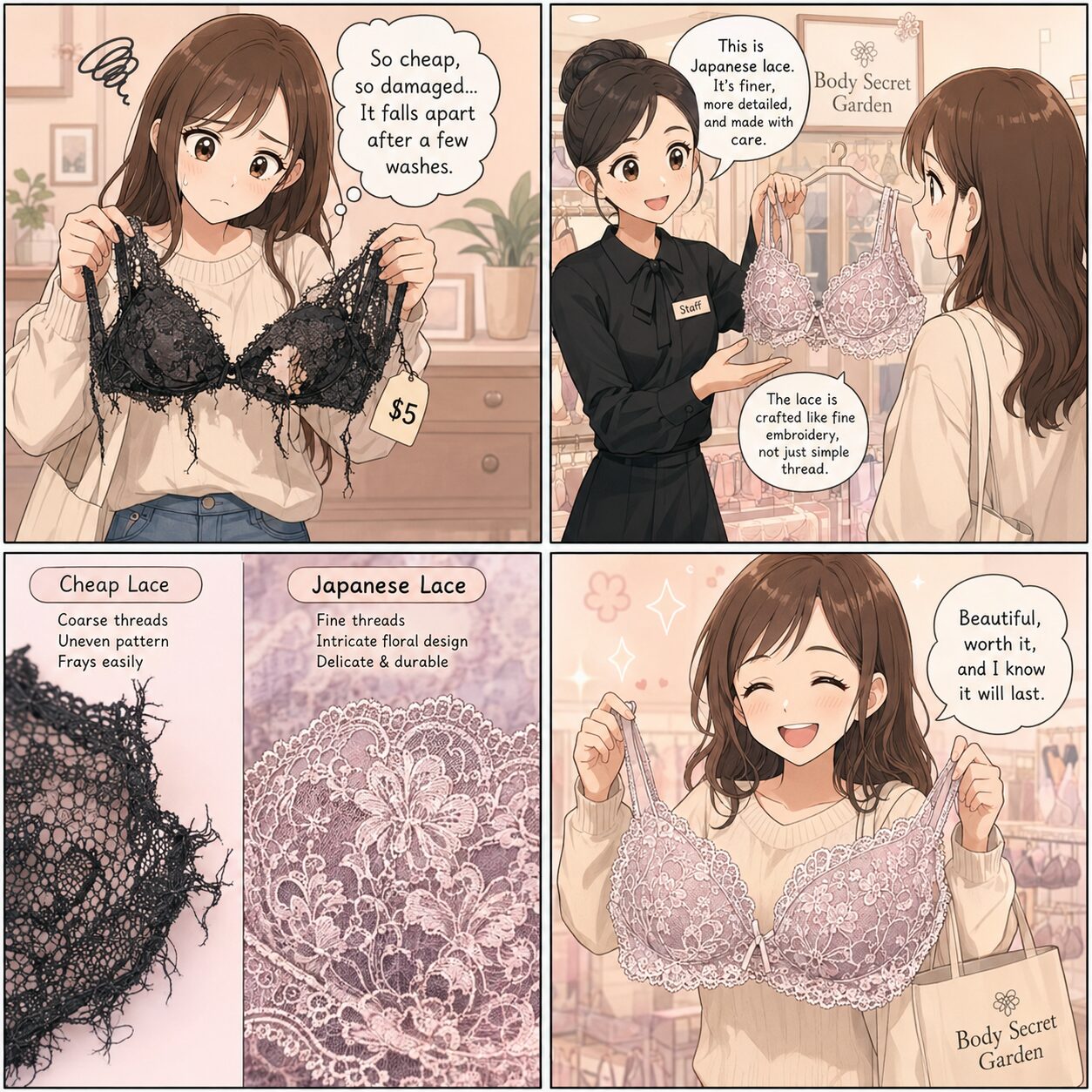
class="manga-img" src="https://bodyse.online/wp-content/uploads/2026/07/blog-9.jpg" alt="4-panel manga comparing cheap lace vs Japanese lace lingerie" >Not all lace is created equal. If you have ever bought a cheap lace bra only to find it scratchy, falling apart, or looking nothing like the photo after a few washes, you already know the difference. Japanese lace is in a category of its own — and once you understand why, it is hard to go back.
1. The History Behind Japanese Lace
Japan has been refining textile manufacturing for centuries. The precision and attention to detail rooted in Japanese craftsmanship — the same philosophy behind everything from ceramics to sushi — carries directly into its lingerie industry. Japanese lace mills, many of which have operated for decades, produce fabric to standards that are simply not required in mass-market production.
2. Thread Count and Yarn Quality
Japanese lace uses finer, higher-quality yarns than most imported alternatives. The result is a fabric that is softer against the skin, more flexible, and far more durable. Cheap lace often uses coarser threads that feel scratchy and break down quickly, especially around delicate areas like underwire casings and strap attachments.
🌸 Key difference: Japanese lace maintains its shape and softness through dozens of washes. Budget lace stretches out, pills, or unravels within months.
3. Pattern Precision
Look closely at a piece of Japanese lace and you will notice the pattern is perfectly consistent — every flower, every geometric repeat, every scalloped edge is exactly as intended. This precision comes from advanced Raschel loom technology combined with rigorous quality control at every stage of production.
In contrast, cheap lace often has inconsistent patterns, loose threads, and uneven edges that become more noticeable after washing.
4. How It Feels Against Your Skin
This is where the difference is most obvious. Japanese lace is engineered to be worn close to the body all day. It is soft, smooth, and non-irritating — even for sensitive skin. The edges are finished carefully to prevent scratching, and the structure holds without digging in.
🌸 Sensitive skin tip: If you have experienced irritation from lace before, the issue is almost certainly the lace quality, not lace itself. Japanese lace is a completely different experience.
5. Durability — A Direct Comparison
| Feature | Cheap Lace | Japanese Lace |
|---|---|---|
| Softness | Scratchy, stiff | Soft, skin-friendly |
| Pattern consistency | Uneven, irregular | Precise, uniform |
| Durability | Pills and frays quickly | Holds shape after many washes |
| Edge finish | Rough, unfinished | Smooth, carefully finished |
| Elasticity | Stretches out fast | Retains stretch long-term |
6. Why Japanese Lingerie Brands Use It
Japan's top lingerie brands — and the smaller ateliers that supply boutiques like ours — source their lace from domestic mills because the quality cannot be replicated at the price points required by fast fashion. The lace is more expensive to produce, which is why Japanese lingerie costs more. But the investment is in something that will last, feel good every day, and look beautiful long after a cheap alternative has been discarded.
7. What to Look for When Buying
- Feel the lace before buying — it should feel smooth, not scratchy
- Check the pattern edges — they should be clean and consistent
- Look at the stitching where lace meets fabric — it should be flat and secure
- Check the care label — quality lace will always recommend hand washing or delicate cycle
Experience the difference of Japanese lace for yourself — explore our collection of premium lace lingerie, made in Japan.
Shop Lace Lingerie